
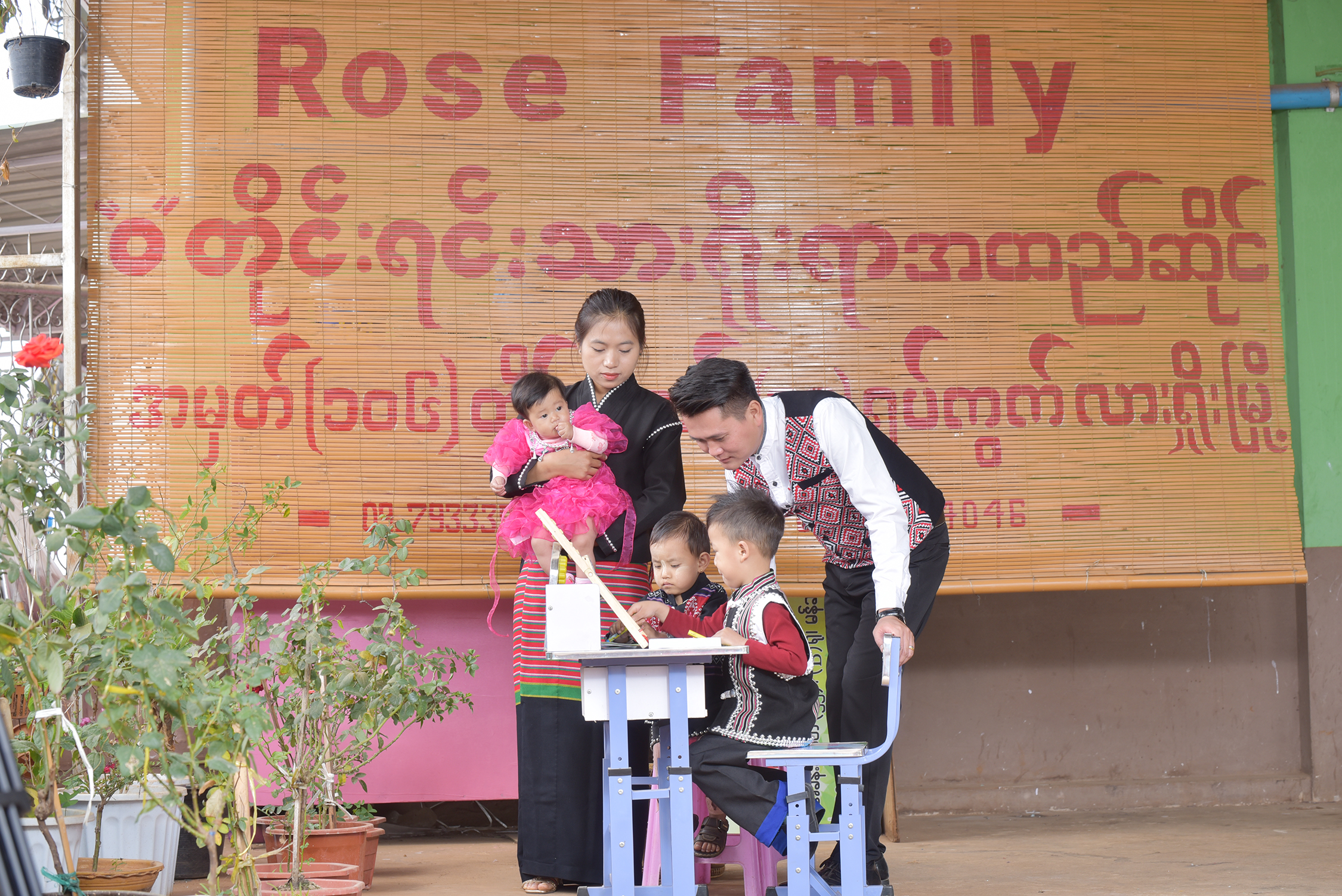
On a bustling street in Lashio township, Myanmar, the “Rose Family” shop displays the colorful and unique clothing designs of entrepreneurial couple Kyaw Lin Aung (34 yrs.) and Rose Htwe Su Maung (32 yrs.). Located in the mountainous northern region of Shan State, along the border with China, Lashio is home to the Wa people, who have beautiful traditions and clothing, little known outside of the Wa community.
“When I moved to Lashio, my wife’s native town, I saw many traditional clothing shops,” explained Kyaw Lin. He was drawn to the colorful fabrics, but noticed that unlike the modernizing of traditional styles he had seen in his native Mandalay, the shops in Lashio only offered traditional style Wa clothing. “I got the idea to make western style clothing with the traditional Wa cloth. That’s why we started this business.”
Before they were married, Kyaw Lin worked in his aunt’s Batik fabric shop in the main market of Mandalay, supplying the entire region with the special Indonesian fabric. In Lashio, Rose had opened a small sewing accessories shop. When they married, their common experience supplying tailors and interest in fashion led them to dream of building a fashion business together. They built up the small haberdashery shop that Rose had started, working hard to expand and pouring the profits back into to the shop, but they struggled to finance the many creative ideas they had to expand.
Through a friend, they learned about VisionFund’s loans for small business people like them, and attended a training at the VisionFund branch on how to use a loan to effectively grow their business. In 2017, they received their first loan of 1,200,000MMK (US$677) which they used to add new inventory to their shop. Quickly they sold the inventory, repaid the loan and took a second loan of 2,000,000MMK (US$1128), which they used to purchase a garment fusing press machine. With that machine, they provided new services to local tailors. Still, they aspired to do more—designing new clothing that fused modern design and traditional Wa textiles. So, their loan officer recommended the “small and growing business” (SGB) loan to them, designed for entrepreneurs whose business is outgrowing typical microfinance loans.
Their first SGB loan of 6,000,000MMK (US$3375) in 2019 allowed them to design, make and sell the first of their very own fashions. “Wa men traditional vests don’t look like the western vest. So, we created a new design by combining the western style with the Wa traditional cloth. For a wedding dress, we made a Burmese wedding dress with Wa designed cloth. Customers hadn’t seen these kinds of design before we made them,” explained Kyaw Lin. These new designs were a hit, and sales quickly began to rise. They added staff to their shop to keep up, but then found that they were overwhelming their hand-woven textiles suppliers. They then discovered that by paying the weavers in advance the weavers could purchase enough raw materials to work more quickly and would give preference to their orders. So, they used a second SGB loan to order and prepay for the materials they needed to keep up with demand.
When COVID reached Lashio in 2020, new challenges quickly emerged. First, the festivals and events which drive the demand for their main product nearly ceased. Ever the resourceful entrepreneurs though, Rose and Kyaw Lin quickly adapted their products to include fashion accessories such as purses, bags, backpacks and household products like bedsheets, towels, tablecloths with the hand-woven Wa traditional textile. Again, they quickly found they had hit products on their hands. Then, as in-person selling was limited, they shifted to online shops and live sales on social media, which not only made up for lost in-person sales, but also expanded their sales into nearby China. Kyaw Lin proudly noted, “After we do online live sales, we are busy for the next three days just sending the orders.”
The couple credits the business coaching, provided with their SGB loans, with helping them to adapt as they have faced the many challenges of rapid growth and multiple crises. They especially appreciate the network that the coaching provides: “we get the chance to learn from the experiences, journey, achievements, and struggles of other small business people who I don’t know. We can do peer-learning with each other, especially how we are struggling during the crisis time.”
Today, the shop is thriving despite the ongoing crises. They have seen revenues rise from about 500,000MMK (USD282) per week the early days of the shop to about 5,000,000MMK per week (USD2821) today, and they have hired three full-time employees. They also contract with six seamstresses to keep up with the demand, and they have recently taken a third SGB loan to expand into wedding dresses. Their four-year-old son has also jumped into the business recently, modeling his parent’s fashions for their advertisements. The couple notes with a bit of a laugh, they dream of having a daughter soon to pass this business on to…and to model the girl’s clothing.
They are proud of their flourishing business and impact on their community. “The profits can support my family and employees, and the employee’s income can support their families,” noted Kyaw Lin. Their family has also taken in five children from the Wa village of MongYun where armed groups have made life unsafe for children. “We can support the children who are living with us when they go to school. When they need tuition, we support it,” the couple explained.
They are also proud of their work to promote and modernize the beautiful Wa traditional clothing. “There are many shops in Lashio selling Wa Traditional clothes. We want to create a new way of fashion design without losing the essence of Wa tradition,” Kyaw Lin said.
Our customers always say they are thankful for promoting their traditional costumes. At the beginning, there were some people who didn’t like the change. Now, in the wedding and social event, Wa costumes are becoming more visible, fashionable and modernized, and our customers feel that their traditional clothing is more valuable.