
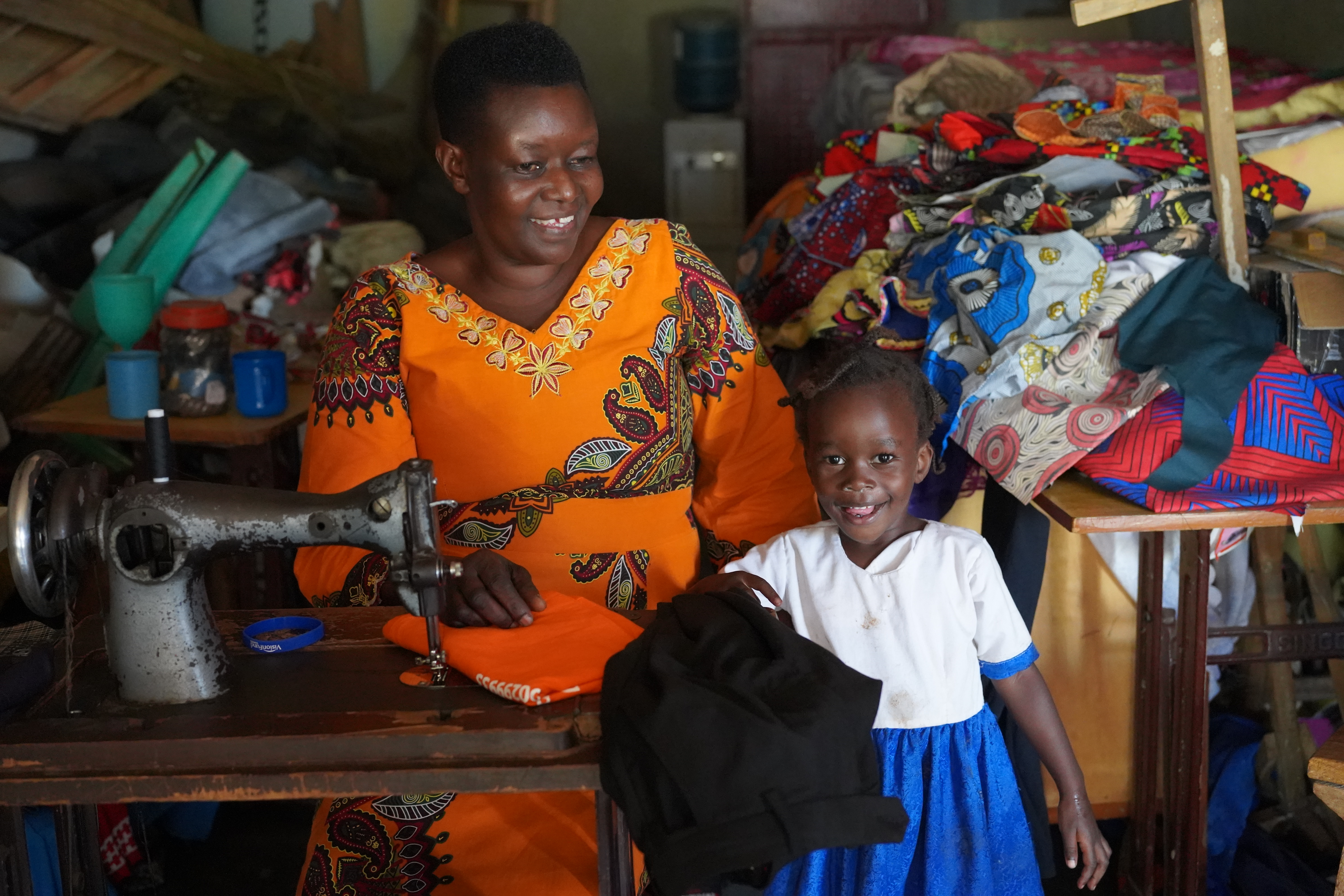
Atino is a dressmaker whose steady hands and strong spirit have not only transformed her own family’s life but have also nourished hundreds of others through opportunity and hope. She and her husband, Geoffrey, have six children.
“Our eldest passed away in 2022 after an accident,” she says quietly. “That was a painful time, but we found strength in each other and in our faith.”
Their second child has since graduated with a degree in electrical engineering, while two are in secondary school, one in primary, and the two youngest are still in pre-school.
Before VisionFund, the financial inclusion arm of World Vision, came into their lives, things were different. The couple once ran a small restaurant and even supplied food to World Vision from 2010 to 2011. When their contract ended in 2019, they struggled to keep up with bills and school fees despite having loyal customers.
“We used to eat mostly beans and cassava,” Atino recalls. “Sometimes it was hard to get even two meals a day.”
That changed when they joined VisionFund Uganda in 2017. Atino took her first loan of 2 million UGX ($552), hoping to cover her children’s school fees for the year.
“They were supposed to stay home that term because we didn’t have enough,” she says. “That loan helped us keep them in school.”
But it did more than that. It opened the door to new opportunities.
Atino used part of the loan to start a small tailoring business. She had learned dressmaking back in 2004 through an on-the-job training and later upgraded her skills in other institutions.
“When I got my first VisionFund loan, I had only one sewing machine,” she says. “I started tailoring seriously that year.”
Her husband was running a small tuckshop at the time, but business was slow.
“I convinced him to join me,” Atino laughs. “I even taught him how to sew!” When there was a gap for someone to operate one of the machines, Geoffrey stepped in—and never looked back.
With each loan cycle—now six in total—the family’s business and income grew. From earning barely UGX 200,000 ($55) a month, they now make around UGX 1.5 million ($414).
They’ve gone from renting a house to buying land and building two homes, one of which they rent out for extra income. They’ve also ventured into farming, purchased a construction truck for hire, and a tukutuku (tricycle) that helps them transport materials and goods. Most importantly, their family’s health and nutrition have improved.
“We used to eat beans and cassava almost every day,” Atino says. “Now, we can eat rice, matoke (starchy banana), meat, fish, and chicken. We eat three times a day.”
They even have medical insurance for their children, something they never imagined before.
Atino’s success didn’t stop with her own family. Over time, she’s turned her tailoring workshop into a place of learning and empowerment.
“I’ve trained more than 500 young girls now,” she says proudly. “Many come from families that can’t afford to keep them in school. I charge a small fee of UGX 150,000 ($41) a year, divided into three terms—just to cover training materials.”
In 2017, a nonprofit organisation also partnered with her to train vulnerable girls, sending batches of 80, 50, 20, and 30 trainees over the years.
“I started with only one machine,” Atino smiles. “Now, I have 13 machines, including nine industrial ones and two for button-making.”
The ripple effect of her work is visible in the community. “One of my students even opened her own tailoring school,” Atino says. “My husband helps coordinate and manage our operations.”
When asked about her dreams, Atino doesn’t hesitate. “I want to expand and open another branch,” she says. “And one day, I’ll build a big school for tailoring so I can train even more girls.”
She also dreams of giving her children the education she never had. “I want them to study to higher levels than me. I want them to live better lives.”
Atino’s story is a powerful reminder that change often starts with just one sewing machine. With the right financial tools and support, one can stitch not only beautiful clothes but also a future full of hope—transforming the lives of not just one family, but over 500 people.
###